

Now offering advanced Process Optimization and CEMS solutions for all major industries.
Shop By Products


“`html
An electromagnetic flow meter measures the flow of conductive liquids in industrial pipelines. It works on Faraday’s law of electromagnetic induction and suits applications where the liquid has enough electrical conductivity. As a result, plants commonly use this technology for water, wastewater, chemicals, slurry, pulp and other process liquid flow applications.
TIPL offers magnetic flow meter solutions for industrial process measurement where stable readings, no moving parts and low maintenance matter. The range includes insertion type and inline electromagnetic flow meters for different pipe sizes, installation conditions and plant requirements. Therefore, users can select the right model based on pipe diameter, conductivity, accuracy, pressure, lining material and output requirement.
This technology differs from mechanical flow meters. Since the measuring tube has no moving parts, it creates low pressure loss and reduces maintenance. Moreover, many configurations can measure forward and reverse flow. However, users should select this technology only for conductive liquids, not for non-conductive media such as pure oil, gas or steam.
| Product | Best Fit | Review Product |
|---|---|---|
| TMF/C Series | Insertion type magnetic flow measurement for large pipelines where full-bore installation may become difficult or costly. | Insertion Type Electromagnetic Flow Meter |
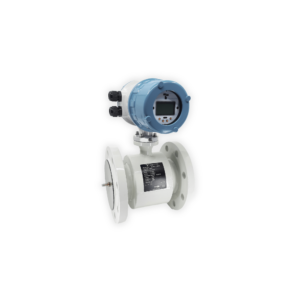
| TMF-T | Inline flanged magnetic flow measurement for conductive liquids such as water, wastewater, chemicals, slurry and process fluids. | Electromagnetic Flow Meter |
Many industrial liquid applications need stable and reliable volume flow measurement. For example, water treatment, wastewater, cooling water, chemical dosing, slurry transfer and utility lines often need continuous flow monitoring. Therefore, plants often choose magnetic flow technology when the liquid conducts electricity and the process needs dependable readings.
In addition, the absence of moving parts helps reduce mechanical wear compared with rotating flow technologies. This makes the meter practical for many dirty or slurry-based applications. However, users must choose the lining material, electrode material and installation method according to the process media.
An insertion type meter helps in large pipelines where pipe cutting or full-bore meter installation may create cost, shutdown or space challenges. In addition, users may choose it for applications where hot-tap installation makes sense, subject to site feasibility and safety practice.
An inline meter works well when the user can modify the line and prefers a full-bore flanged flow meter. Plants often select it for process lines where accuracy, lining compatibility, electrode material and long-term measurement stability matter.
Correct selection starts with the liquid. First, confirm that the fluid conducts electricity and suits magnetic flow measurement. Next, check pipe size, flow range, pressure, temperature, lining material, electrode material and installation space. After that, review output signal, communication protocol and display requirement.