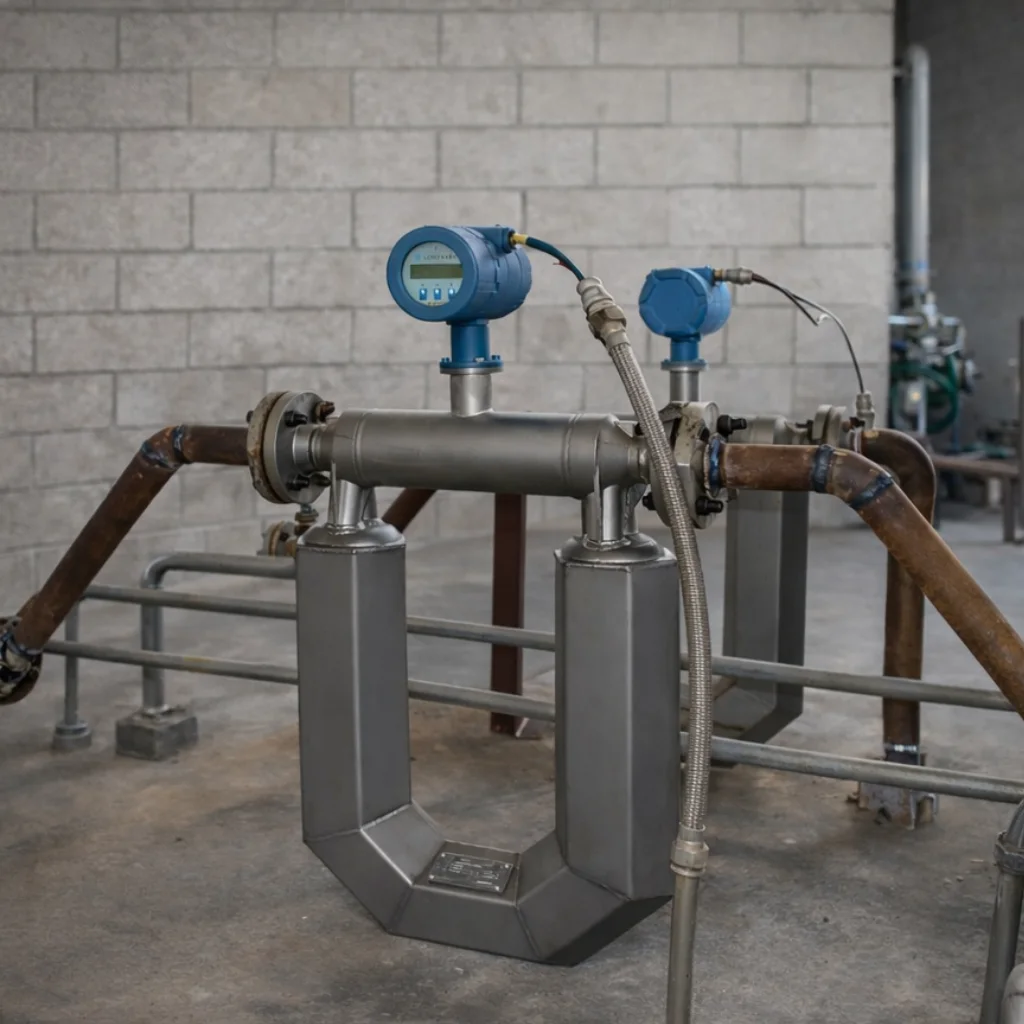
Coriolis Mass Flow Meter for Direct Mass Flow Measurement
A coriolis mass flow meter measures mass flow directly instead of calculating it only from volume flow and external process parameters. This makes it useful for industrial applications where accuracy, repeatability and process reliability matter. As a result, users can measure mass flow more confidently in suitable liquid and gas applications.
TIPL offers Coriolis flow meter solutions for process industries where mass flow, density, temperature and stable measurement are important. These meters can support applications in chemical processing, oil and gas, food and beverage, pharmaceuticals, marine and other industrial sectors.
Unlike many volumetric flow meters, this technology can provide direct mass flow measurement. In addition, it can also support density and temperature-related output depending on configuration. Therefore, it is useful where users need more process information from one flow measurement instrument.
Product in This Category
| Product |
Best Fit |
Review Product |
| TCMF Series |
Industrial mass flow and density measurement for suitable liquid and gas applications requiring high accuracy and stable output. |
Coriolis Mass Flow Meter |
Why Coriolis Technology Matters
Many industrial processes need accurate measurement of actual material movement. For example, loading, unloading, batching, dosing and chemical processing applications may need mass flow instead of only volume flow. Therefore, Coriolis technology is often selected where measurement accuracy has a direct impact on process control or material accounting.
In addition, Coriolis meters can help reduce intermediate calculation errors because they measure mass flow directly. This can be helpful where density changes, temperature variation or changing process conditions may affect volumetric measurement.
Common Industrial Applications
- Chemical processing flow measurement
- Oil and gas liquid measurement
- Loading and unloading applications
- Batching and dosing systems
- Food and beverage process measurement
- Pharmaceutical process flow measurement
- Marine fuel and liquid flow applications
- Density-related process monitoring
- High-accuracy liquid mass flow measurement
- Suitable gas mass flow measurement applications
When to Choose a Coriolis Flow Meter
A Coriolis flow meter is useful when the application requires direct mass flow measurement, high repeatability or density-related process information. It is also useful when process conditions may affect volumetric flow readings and users need a more direct measurement method.
However, final selection should depend on the actual process. Users should review media type, flow range, density, viscosity, pressure, temperature, line size, connection type and required accuracy before choosing the meter.
How to Select the Right Mass Flow Meter
Correct selection starts with process data. First, identify the media and required flow range. Next, check process temperature, pressure, density, viscosity and accuracy requirement. After that, review installation space, connection standard, power supply, communication output and maintenance access.
- Media Type: Confirm whether the application is for liquid, gas or a special process fluid.
- Flow Range: Check minimum, normal and maximum mass flow before selecting meter size.
- Accuracy Requirement: Select accuracy based on batching, loading, process control or monitoring need.
- Process Conditions: Review pressure, temperature, viscosity, density and operating stability.
- Output Signal: Check 4-20 mA, pulse, HART, RS485 or Modbus communication requirement.
- Installation: Review pipe size, mounting arrangement, vibration, support and accessibility.
- Maintenance: Consider calibration, inspection and service access before final selection.
Related Flow Measurement Categories
Industries Using Coriolis Flow Meters
- Oil & Gas
- Chemicals & Fertilisers
- Food & Beverage
- Power
- Steel
- Metals
- Water