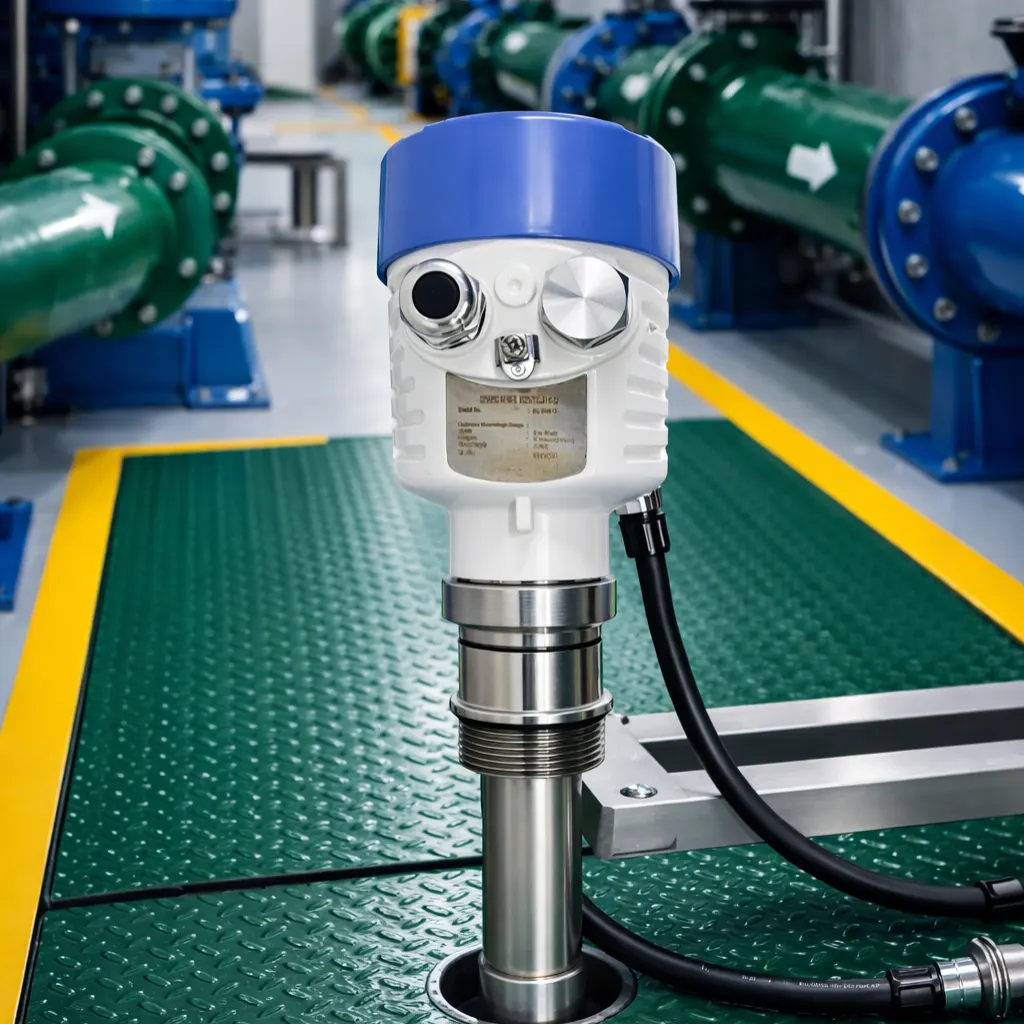
Guided Radar Technology for Continuous Tank Level Monitoring
A guided wave radar level transmitter measures level by sending microwave pulses along a probe, cable or coaxial guide. When the signal reaches the product surface, part of the pulse reflects back to the instrument. The transmitter then calculates the level from the signal travel time.
TIPL offers guided radar solutions for continuous level monitoring in suitable tanks and process vessels. This technology works well where contact-based measurement is acceptable and where vapor, foam, condensation or buildup may affect some other level technologies. As a result, users can apply it in many liquid applications after checking the process condition and probe selection.
This technology is different from non-contact radar. In non-contact radar, the signal travels through air from the antenna to the surface. However, in guided radar, the microwave signal follows the probe path. Therefore, it can provide stable measurement in selected difficult vessel conditions when the application suits probe-based installation.
Product in This Category
Why Guided Radar Level Measurement Matters
Many vessels have process conditions that make simple level sensing difficult. For example, foam, vapor, condensation, buildup, turbulence or changing dielectric conditions may disturb some instruments. In such cases, a probe-based radar technology can help because the signal follows a defined path.
In addition, guided radar can support continuous monitoring without moving mechanical parts. This reduces wear compared with float-based or mechanical systems. However, users must check probe type, mounting, vessel height, nozzle condition, buildup tendency and media compatibility before final selection.
Common Industrial Applications
- Continuous tank level monitoring
- Liquid level monitoring in process vessels
- Storage tank level indication
- Foam or vapor-prone vessel applications
- Condensation-prone tank applications
- Low-pressure and high-pressure vessel monitoring
- Chemical tank level monitoring
- Utility tank level monitoring
- Process liquid level control
- Applications requiring rod, cable or coaxial probe selection
Probe Selection: Cable, Rod and Coaxial Options
Probe selection affects performance and installation suitability. A cable probe can support taller tanks where flexible installation is needed. A rod probe suits shorter vessels and applications where rigid probe mounting is preferred. A coaxial probe can help in selected applications where a guided signal path is required around the probe.
Therefore, the selection should not depend only on measuring range. Users should also check media type, dielectric constant, process temperature, pressure, nozzle size, agitation, buildup and available tank height.
How to Select the Right Guided Radar Instrument
Correct selection starts with application data. First, identify the medium and required measuring range. Next, check process temperature, pressure, vapor, foam, buildup, tank height and nozzle details. After that, select the probe type, process connection, output signal and housing requirement.
- Medium: Confirm whether the product is conductive or non-conductive and check dielectric behavior.
- Range: Match cable, rod or coaxial probe selection with the tank height and required span.
- Process Condition: Review temperature, pressure, foam, vapor, condensation, agitation and buildup.
- Mounting: Check nozzle size, flange or thread requirement, top clearance and probe anchoring need.
- Output: Confirm 4–20 mA, HART, two-wire or four-wire requirement.
- Housing: Review IP protection, material, display and cable entry requirement.
- Site Safety: Check grounding and surge protection requirements during installation.
Related Level Measurement Categories
Industries Using Guided Radar Level Instruments
- Chemicals & Fertilisers
- Oil & Gas
- Power
- Water
- Steel
- Cement
- Metals
- Food & Beverage