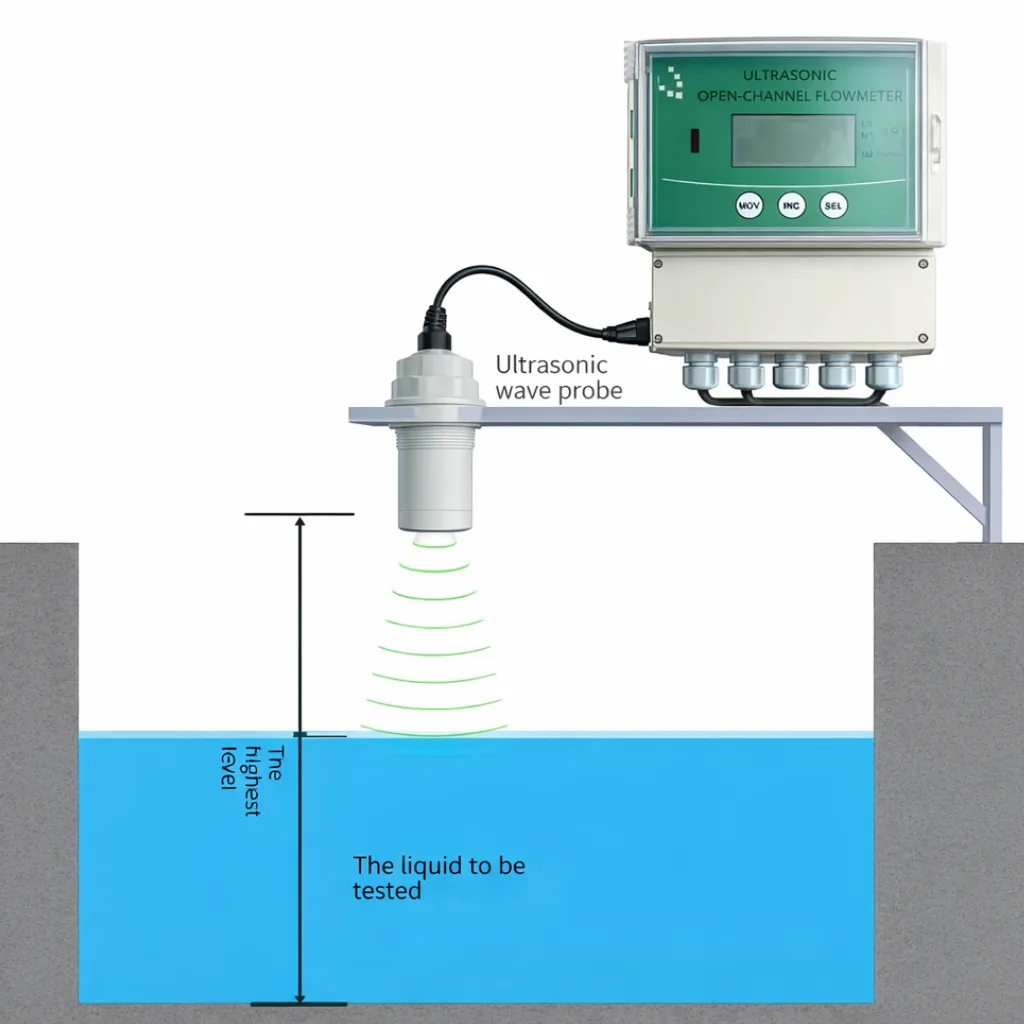
Remote Ultrasonic Level Transmitters for Difficult Mounting Areas
A remote ultrasonic level transmitter measures level without touching the process media. The sensor mounts near the tank, sump or vessel, while the display or transmitter unit can be installed at a safer or more accessible location. As a result, users can monitor level where tank-top access, vibration, temperature, enclosure position or viewing convenience matters.
TIPL offers remote-type ultrasonic models for industrial liquid and selected solid level applications. This arrangement helps when operators need the sensor at the measuring point but prefer the electronics away from the process area. Therefore, it can support tank farms, sumps, water treatment areas, chemical storage, utility tanks and process vessels.
Remote ultrasonic technology works best when the sensor has a clear echo path to the surface. However, foam, vapor, dust, turbulence, narrow nozzles, angled surfaces and strong agitation can affect performance. Therefore, users should review the actual installation condition before selecting the model.
Products in This Category
for non-contact level monitoring in suitable tank and vessel applications.
| Product |
Best Fit |
Review Product |
| TLTV1000A3 |
Remote ultrasonic level monitoring where sensor and display need separate installation for better access or safety. |
Ultrasonic Level Transmitter |
| TLTV1000A4 |
Separate sensor and transmitter arrangement for non-contact level monitoring in suitable tank and vessel applications. |
Ultrasonic Level Transmitter |
Why Remote Type Selection Matters
In many sites, the best sensor location is not the best display or maintenance location. For example, the tank top may be high, difficult to access, exposed to weather or located near splashing and vapor. In such cases, a separate transmitter arrangement can make operation and commissioning easier.
Also, remote mounting helps users keep electronics away from selected harsh or inconvenient areas. This can improve accessibility during configuration, troubleshooting and routine checks. However, the sensor cable route, distance, protection and grounding should be reviewed during installation.
Common Industrial Applications
- Water tank level monitoring
- Wastewater sump and pit monitoring
- Chemical storage tank monitoring
- Utility tank level indication
- Open vessel level monitoring
- Effluent tank monitoring
- Process tank level monitoring
- Remote display requirement near operating area
- Tank-top sensor with ground-level transmitter installation
- Non-contact level monitoring where electronics need safer placement
Integral Type vs Remote Type
An integral ultrasonic model combines the sensor and electronics in one compact unit. It suits applications where the instrument is easy to access and local mounting is practical.
A remote type separates the sensor from the display or electronics. This works better when the sensor must sit on the tank, but operators need the transmitter at a convenient location. Therefore, site access, cable route and maintenance practice should guide the choice between both designs.
How to Select the Right Remote Ultrasonic Model
Correct selection starts with the tank and sensor location. First, check tank height, measuring range, blind zone and maximum level. Next, review media surface, vapor, foam, temperature, pressure, turbulence and obstacles. After that, confirm cable distance, output signal, power supply and mounting arrangement.
- Media: Confirm liquid, slurry, foam tendency, vapor, dust or surface disturbance.
- Range: Match the model with tank height, working span and blind zone.
- Sensor Location: Check clear echo path, nozzle size, mounting angle and tank roof condition.
- Transmitter Location: Select a safe and accessible place for display, wiring and commissioning.
- Cable Route: Review cable distance, protection, grounding and routing through plant areas.
- Output: Confirm 4–20 mA, relay, RS485, HART or local display requirement.
- Environment: Review outdoor exposure, IP protection, corrosion, vibration and maintenance access.
Related Level Measurement Categories
Industries Using Remote Ultrasonic Level Instruments
- Water
- Chemicals & Fertilisers
- Power
- Steel
- Cement
- Oil & Gas
- Metals
- Food & Beverage