INDUSTRIAL PROCUREMENT / BUYER’S GUIDE
Choosing an industrial thermocouple manufacturer in India involves more than finding a company that offers Type K, J or S sensors. The right manufacturer should be able to supply a thermocouple assembly that matches your process temperature, operating environment, installation arrangement and documentation requirements.
Before shortlisting a manufacturer, check five things:
- Application suitability: Can the proposed thermocouple operate under the actual temperature and process conditions?
- Construction capability: Can the supplier provide the required sheath, dimensions, junction and connections?
- Quality evidence: What standards, inspection records and calibration documents apply to the proposed product?
- Technical clarity: Can the manufacturer identify missing specifications and explain any deviations?
- Quotation completeness: Are you comparing equivalent assemblies, not simply the lowest prices?
There is no universal “best” manufacturer for every industrial application. A supplier suitable for a standard replacement probe may not be the right choice for a specially designed high-temperature or corrosive-process assembly.
This guide explains how to evaluate manufacturers and prepare a more useful request for quotation (RFQ).
Already have a specification? You can review TIPL’s industrial thermocouple range and use the product page’s Get a Quote option. If your requirement is not yet complete, work through the evaluation and RFQ checks below first.
1. Look Beyond the Thermocouple Type
A thermocouple is a temperature sensor that produces a thermoelectric voltage related to the temperature difference between its measuring junction and reference junction. Different thermocouple types use different conductor combinations and have different temperature–EMF characteristics.
Industrial buyers commonly encounter Types J, K, T, E, N, R, S and B. However, selecting the thermocouple type is only one part of specifying a complete sensor assembly.
Consider two quotations that both offer a Type K thermocouple. One may propose a mineral-insulated, metal-sheathed probe with a particular diameter and junction arrangement. The other may specify a different sheath, construction or connection. Even though both are Type K, they may not be interchangeable for the intended installation.
KEY TAKEAWAY
The first question for a manufacturer is not simply “Do you supply Type K?” It is “Can you supply the complete Type K assembly required for this process?”
Ask for a product datasheet or assembly drawing that identifies the proposed construction and any operating limitations.
2. Check Whether the Manufacturer Understands Your Application
A useful supplier evaluation starts with the process, not the catalogue.
The requirements for a thermocouple in a furnace, pipeline, reactor or machinery installation can differ substantially.
On smaller screens, swipe sideways to see the full table.
| Application consideration | What to communicate to the manufacturer | Why it matters |
|---|---|---|
| Temperature | Normal operating range, peaks and cycling | Helps assess the thermocouple type and construction |
| Process atmosphere | Air, combustion products, reducing atmosphere or other relevant gases | Can affect the suitability and life of sensing materials and protection |
| Process medium | Gas, liquid, solids or other medium | Influences protection and mechanical requirements |
| Pressure and flow | Operating conditions where applicable | May affect the need for an appropriately designed thermowell or protection arrangement |
| Mechanical conditions | Vibration, abrasion, movement and installation constraints | Influences construction and support |
| Maintenance | Access, replacement method and expected servicing needs | Helps establish practical assembly and installation requirements |
A manufacturer should evaluate these conditions rather than assume that an advertised maximum temperature applies to every configuration.
For example, the allowable operating temperature of a complete assembly may be limited by its sheath, insulation, junction arrangement, termination or surrounding environment—even when the thermocouple conductors themselves have a broader reference range.
ENGINEERING NOTE
For critical or demanding installations, obtain written confirmation of the proposed assembly’s suitability for the specified conditions.
3. Evaluate the Required Thermocouple Construction
Industrial thermocouples are not necessarily interchangeable simply because they share the same type designation.
Before choosing a manufacturer, confirm whether the required construction is available and properly documented.
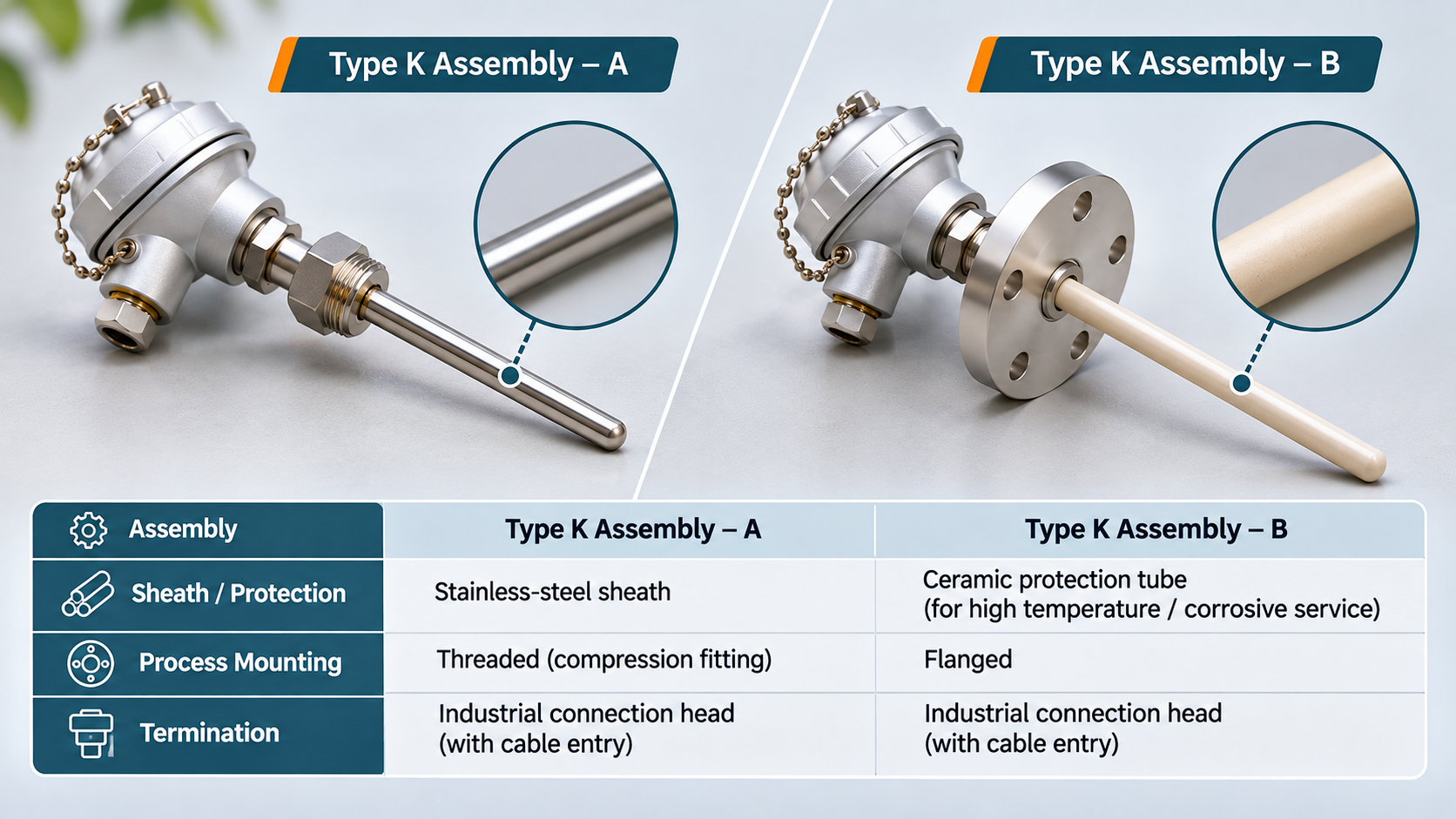
Sheath and protection materials
The sheath or protection arrangement may be exposed to heat, corrosion, abrasion or mechanical stress. Its material and dimensions need to suit the actual environment.
Do not choose a sheath solely because a material is marketed as “high temperature” or “corrosion resistant.” Compatibility depends on the process medium, temperature and conditions of use.
Probe diameter and insertion length
The diameter and insertion length influence installation fit, mechanical behaviour and measurement performance.
An assembly that is too short, incorrectly positioned or incompatible with the process connection may not measure the intended process temperature reliably.
Where replacing an existing sensor, provide the manufacturer’s drawing or a verified dimensional specification rather than estimating the required length.
Measuring-junction configuration
Grounded, ungrounded and exposed-junction designs can have different implications for response, electrical isolation and environmental protection.
The correct choice depends on the measuring system and application. An exposed junction, for instance, should not be assumed suitable for a harsh process merely because rapid response is desirable.
Terminations and connections
Confirm the intended arrangement, such as a terminal head, connector or cable termination, along with its environmental and electrical requirements.
Also verify the compatibility of the thermocouple extension or compensating cable and the receiving instrument. Incorrect wiring or incompatible components can introduce measurement errors even when the probe itself is correctly specified.
BUYER CHECKPOINT
Buying tip: Request one complete assembly specification rather than separate, ambiguous descriptions of the sensor type, sheath and connection.
4. Verify Standards, Testing and Calibration Evidence
A manufacturer’s product claims should be supported by documentation relevant to the particular assembly being purchased.
Thermocouple standards
IEC 60584-1 and the corresponding Indian Standard IS 16923 (Part 1):2018 address thermocouple reference EMF specifications and tolerances. ASTM E230/E230M is another recognized reference covering standardized thermocouple temperature–EMF relationships.
These references are useful for specifying the thermocouple type and applicable tolerance requirements.
However, conformity to a thermocouple EMF standard does not automatically establish the mechanical suitability, process compatibility or calibration status of a complete assembly.
Depending on the product and application, additional specifications may be required for construction, materials, testing or installation.
Inspection and test documents
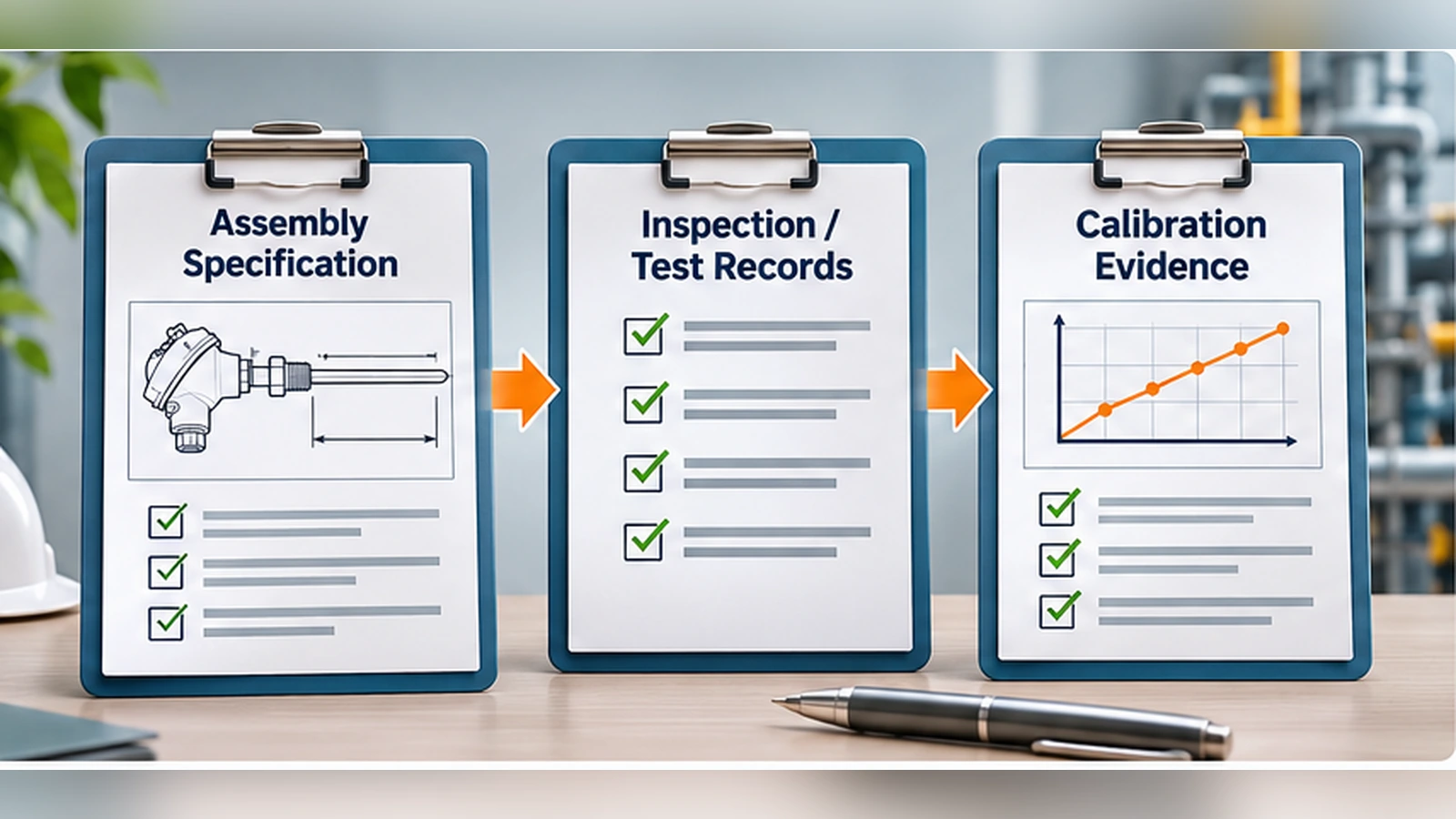
Ask which documents can accompany the actual order. Depending on the requirement, these may include:
- Assembly drawings or product specifications
- Material or construction details
- Relevant inspection and test records
- Confirmation of applicable tolerance requirements
- Calibration certificates, when requested and available
A catalogue statement and an order-specific test record are not equivalent evidence. Confirm what will actually be supplied.
Calibration and traceability
If calibration evidence is required, specify the calibration points, measurement range, reporting expectations and any accreditation requirement.
Where NABL accreditation is important, verify the issuing laboratory’s current status and whether its accredited scope covers the relevant measurement and calibration service.
An accredited laboratory may have a defined scope that does not cover every instrument, method or range.
EVIDENCE CHECK
What matters is not simply whether a supplier mentions calibration, but what has been calibrated, by which method, over which range and with what supporting documentation.
For an example of the supporting services to discuss during supplier evaluation, see TIPL’s calibration services. Confirm the relevant service and documentation scope for your particular enquiry.
5. Assess Custom Manufacturing and Replacement Capability
Some industrial purchases involve standard catalogue configurations. Others require an assembly made to suit an existing installation or an OEM design.
When evaluating a thermocouple manufacturer, ask whether it can review and quote against the relevant engineering details.
For a custom assembly, the enquiry may need to include:
- Required thermocouple type and number of sensing elements
- Sheath and protection requirements
- Probe diameter, length and mounting dimensions
- Measuring-junction and termination arrangement
- Process connection details
- Working environment and temperature profile
- Required drawings, standards and test documentation
For replacement purchases, a photograph alone may not establish compatibility. The existing drawing, model identification, connection details and actual process requirements are usually more useful.
A capable supplier should be able to identify which information is missing and clarify it before confirming the proposed design.
REPLACEMENT CHECK
Do not assume that an assembly can be copied safely without checking whether the original configuration remains suitable for the current process.
6. Compare Quotations on the Same Technical Basis
Price matters, but a low quotation is not necessarily a lower-cost or equivalent solution if critical specifications have been omitted.
Before comparing suppliers, prepare a common RFQ and request responses against the same requirements.
On smaller screens, swipe sideways to see the full table.
| RFQ comparison point | Questions to ask |
|---|---|
| Sensor specification | Is the thermocouple type and required tolerance clearly stated? |
| Assembly construction | Are sheath, junction, diameter, length and termination defined? |
| Application fit | Has the supplier considered the stated temperature, medium and environment? |
| Documentation | Which drawings, inspection records and calibration documents are included? |
| Deviations | Has the supplier disclosed any exceptions or alternatives? |
| Commercial terms | What are the quoted quantity, lead time, delivery terms and validity? |
| After-sales requirements | What replacement, technical clarification or service arrangements apply? |
If two quotations differ substantially, identify the technical differences before deciding that one manufacturer offers better value.
An alternative construction may be acceptable, but it should be evaluated as an explicit deviation rather than treated as equivalent without review.
APPLICATION CAUTION
For safety-critical, high-pressure, hazardous-area or otherwise regulated applications, the relevant plant engineering and approval requirements take precedence over a generic purchasing checklist.
7. Prepare a Clear Thermocouple RFQ
A well-prepared enquiry helps manufacturers evaluate your requirement and reduces avoidable clarification cycles.
Use the following checklist when requesting an industrial thermocouple quotation.
On smaller screens, swipe sideways to see the full table.
| Information to include | Details |
|---|---|
| Application | Equipment, measurement point and intended use |
| Operating conditions | Normal and peak temperature; process medium and atmosphere |
| Thermocouple type | Type K, J, T, E, N, R, S, B or another justified requirement |
| Performance requirements | Applicable tolerance and other measurement expectations |
| Assembly construction | Sheath, protection, junction and sensing-element arrangement |
| Mechanical details | Diameter, insertion length, overall dimensions and mounting |
| Electrical connection | Terminal head, connector, cable and instrument interface |
| Standards and documents | Applicable standards, drawings, inspection and calibration requirements |
| Procurement information | Quantity, delivery location, required schedule and replacement references |
Where specifications are uncertain, state that clearly and request technical clarification rather than guessing.
A useful RFQ might identify the required thermocouple type and installation dimensions while asking the manufacturer to recommend an appropriate sheath construction for the declared process environment. The recommendation would still need to be reviewed for application suitability.
RFQ PRINCIPLE
A complete RFQ is not necessarily one that contains every possible technical detail. It is one that clearly separates confirmed requirements from decisions needing supplier engineering input.
Ready to turn the checklist into an enquiry? Use your known requirements when you request a quotation for an industrial thermocouple. Clearly identify any specifications you want the supplier to help confirm.
8. Should You Choose a Manufacturer or a General Supplier?
The distinction matters most when the order requires a specific construction, documentation package or engineering clarification.
A distributor may be suitable for a well-defined standard replacement product. A manufacturer or assembly specialist may be particularly relevant when the enquiry calls for a custom drawing, unusual dimensions or product-specific design discussion.
However, the supplier’s label alone is not proof of capability. Ask who is responsible for the proposed design, manufacturing or assembly, quality checks, documentation and post-order support.
PROCUREMENT TAKEAWAY
The better choice is the organization that can document its responsibility for the product you are buying.
9. Considering TIPL for an Industrial Thermocouple Requirement
Toshniwal Industries Pvt. Ltd. (TIPL) provides industrial thermocouple products and lists Types J, K, T, E, N, R, S and B in its product range. Its published product information also describes make-to-order construction and support for selecting suitable configurations.
Buyers can review the TIPL industrial thermocouple product page and submit their operating conditions and assembly requirements for evaluation.
When approaching TIPL—or any manufacturer—include the process temperature, environment, sensor type, dimensions, connection details and documentation needs. This allows the enquiry to focus on a defined technical requirement rather than a generic request for “best price.”
Final product availability, construction suitability, documentation and commercial terms should be confirmed through the quotation process.
If you still need clarification before raising a product-specific RFQ, you can contact TIPL with your application details and the points that remain undecided.
Conclusion: Choose the Manufacturer That Can Demonstrate the Right Fit
The best industrial thermocouple manufacturer in India for a particular requirement is not necessarily the supplier with the largest catalogue or the lowest initial price.
A more reliable selection process checks whether the proposed assembly fits the process, whether its construction and documentation are clear, and whether quotations can be compared on the same technical basis.
Start with your application requirements. Shortlist manufacturers that can respond with relevant evidence. Then evaluate the complete technical and commercial offer.
Next step: Prepare your thermocouple specification using the RFQ checklist and request a quotation for the required assembly.
Have your requirements ready? Review TIPL thermocouples and select Get a Quote. Include the operating conditions, assembly details, quantity and documentation needs you know; flag any points requiring confirmation.
Still defining the requirement? Contact TIPL with your application details and the questions you need resolved before ordering.
Technical references
- Bureau of Indian Standards: IS 16923 (Part 1):2018 — Thermocouples, EMF specifications and tolerances
- IEC 60584-1:2013 — Thermocouples: EMF specifications and tolerances
- ASTM E230/E230M-23a — Temperature–EMF tables for standardized thermocouples
- NABL: Find an accredited laboratory and verify accreditation scope
- TIPL: Thermocouple product information